
Start with the service, not the sourcing label
A warehouse contract is approaching renewal. The provider offers automation and a wider network; the business wants closer control of service, stock information and change priorities. Bringing the work in-house might help, but it also means taking on recruitment, systems, facilities and operational risk. The useful question is which delivery model can meet the requirement reliably, at an acceptable whole-life cost.
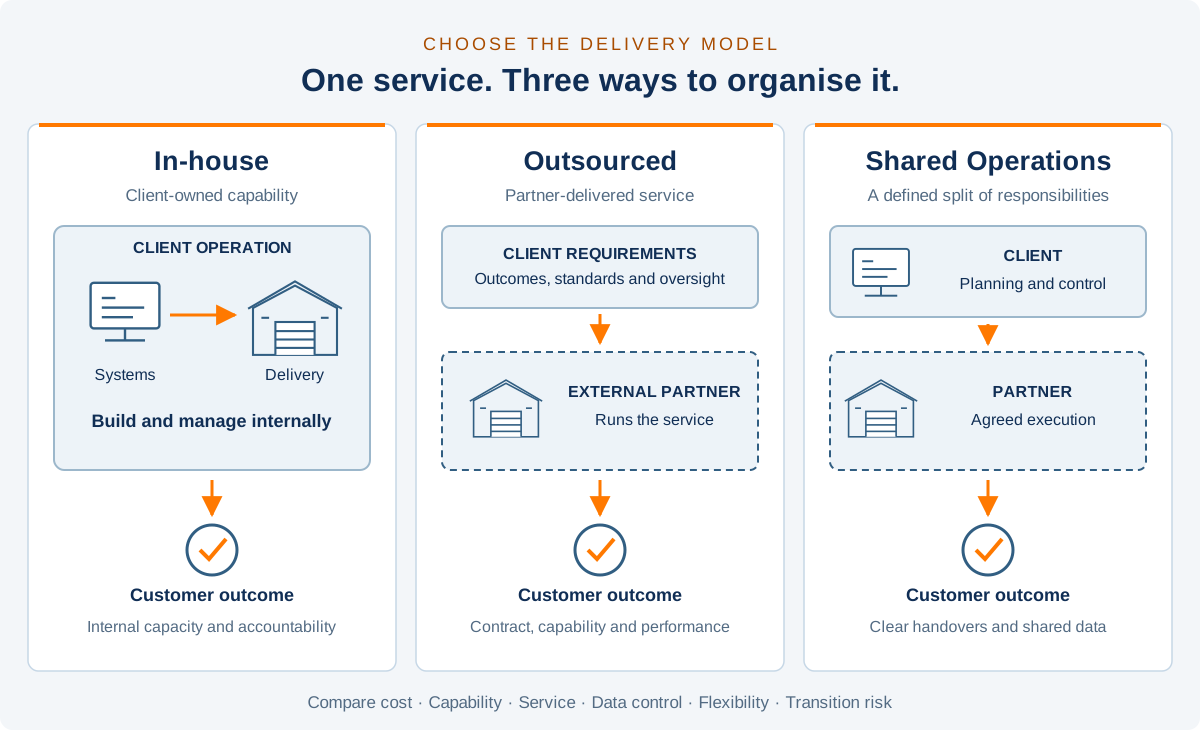
Here, outsourcing means contracting an external organisation to deliver a service. Insourcing means delivering it within the organisation, including bringing previously outsourced work back. A mixed model divides responsibilities between the business and specialist providers. Outsourcing is separate from offshoring: an external provider can be local, and a company-owned team can operate overseas.
Is the industry moving back in-house?
The research points to rebalancing rather than a universal retreat from outsourcing. Deloitte’s 2024 Global Outsourcing Survey, drawing on more than 500 executives globally, describes growing interest in insourcing and global in-house centres alongside continued growth in third-party outsourcing investment. It identifies access to skills and agility as drivers alongside cost. This is consultancy-led survey evidence across business functions, not a measure of warehouse insourcing or proof that one model performs better. [1]
The logistics picture also supports continued use of external partners. The public summary of the 2027 Third-Party Logistics Study, published on 6 October 2026, describes increasingly strategic relationships around service, innovation, resilience and collaboration. It was developed by NTT DATA, Penske Logistics and the University of Tennessee’s Global Supply Chain Institute, with CSCMP support. The publicly available summary was reviewed; the full report is behind a registration form. It does not establish a net rate of switching between insourcing and outsourcing. [2]
SCP interpretation: different activities within the same organisation may move in different directions. A business might retain planning, customer priorities and data governance while using a provider for warehouse execution or transport. Neither survey establishes that legislation is causing a general shift to insourcing.
Why move a service outside, or bring it back?
Reasons to consider outsourcing
- Access capability: obtain specialist people, systems, infrastructure or geographic coverage that would take time and investment to build.
- Match capacity to demand: use a provider’s resources for peaks, expansion or extended operating hours, where the contract actually makes that capacity available.
- Focus internal effort: allow managers and employees to concentrate on activities where the business needs to differentiate, while retaining enough knowledge to manage the service.
- Improve cost or investment choices: test whether shared infrastructure, scale or avoided capital expenditure outweigh supplier margins, integration and contract-management costs.
Robert Walters’ outsourcing guidance emphasises skills, cost and flexibility. As a provider’s commercial perspective, it explains the proposition rather than independently demonstrating an outcome. Fixed costs do not automatically become variable: minimum volumes, dedicated facilities, indexation and exit charges can leave substantial commitments. [3]
Reasons to consider insourcing
- Control a differentiating capability: keep important process knowledge, product decisions or customer interactions close to the business.
- Respond to change: reduce reliance on contractual change procedures where priorities or requirements change frequently.
- Improve accountability: address unclear handovers, slow issue resolution or incentives that no longer match customer needs.
- Restrict exposure: reduce selected external access to sensitive information or proprietary methods, while maintaining effective internal controls.
FTI Consulting’s June 2025 discussion describes client concerns including rising costs, quality issues and disputed accountability, and proposes selective insourcing or a mixed approach. These are practitioner observations from its engagements, not a representative failure rate for outsourcing. [4]
In-house delivery has its own constraints: scarce skills, management workload, technology investment and limited ability to absorb peaks. Direct employment gives greater authority over the team; it does not by itself create the capacity or competence needed to run the service.
What do reported experiences teach us?
A provider can bring operating capability
GXO describes an apparel business moving European logistics from in-house delivery to a provider-operated distribution centre. Its account includes transfer of the workforce, the lease and existing assets, with phased introduction of ecommerce operations. It reports continuity and capital-efficiency benefits, while some longer-term benefits remain expectations. This is an unnamed customer case published by the supplier, without an independently verified like-for-like cost comparison. The useful lesson is to examine the actual operating transfer, not just the outsourcing headline. [5]
Lower cost can coexist with service failure
The National Audit Office’s 2018 review of NHS England’s primary care support contract with Capita found that both parties underestimated complexity and risk. Running, closing and transforming services together proved difficult, and some performance measures remained disputed. The NAO reported savings alongside unacceptable service failures. This is a historical public-service case, not a prediction about logistics providers; it demonstrates why savings, service quality and transition readiness must be assessed separately. [6]
Bringing work back does not remove delivery risk
The Probation Service returned to full public control in June 2021. The NAO’s 2025 review found continued staffing shortfalls, high workloads and worsening performance after unification. The report did not evaluate implementation of the 2021 reform itself, so it cannot establish that insourcing caused those problems. It does show that changing ownership is insufficient without realistic workload, capability and capacity planning. [7]
Data control and confidentiality need their own assessment
Separate personal data, commercially confidential information, intellectual property and practical access to operating records. A service provider processing information does not automatically determine its permitted use, and keeping a team in-house does not automatically make information secure.
For personal data, the ICO’s controller–processor guidance describes contractual requirements covering instructions, confidentiality, security, sub-processors, audits and end-of-contract return or deletion. These obligations support controlled use of external processors; they are not a general instruction to insource. The ICO flags this guidance as under review following the Data (Use and Access) Act. [8]
For proprietary processes and commercial records, agree permitted use, access, confidentiality, intellectual-property rights and usable export arrangements. Check where data is stored and accessed, which subcontractors can see it, and whether overseas access triggers international-transfer requirements. Sector rules may impose additional conditions. Legal and security specialists should assess the actual arrangement before the sourcing decision is approved.
SCP interpretation: retain a named internal owner for the process and its information. Test whether the business can retrieve, understand and use its records independently of the provider’s dashboard. Insourcing may reduce one external dependency while leaving others in cloud hosting, software licensing or specialist support.
A practical framework for the discussion
The UK Government’s Sourcing Playbook recommends evidence-based comparison of in-house, market and mixed delivery models, including whole-life cost and capability. Its requirements apply in a public-sector context; the following is SCP’s proposed discussion framework for a commercial supply-chain decision. [9]
- Define the boundary. Specify activities, volumes, locations, hours, exceptions and required outcomes. Separate demand planning, warehouse execution, transport, systems support and customer-service decisions rather than treating them as one indivisible service.
- Agree non-negotiables. Set customer-service, safety, regulatory, confidentiality and continuity requirements before scoring price. An option that cannot meet an essential condition should not win through a weighted average.
- Compare three credible options. Assess internal delivery, an external service and a mixed model against the same demand and quality assumptions. Include realistic recruitment, technology and mobilisation lead times.
- Build the whole-life cost. Include retained management, integration, training, assets, transition overlap, service failures, change charges and exit or re-entry costs. Test low volumes, peak demand and disruption as well as the expected case. Distinguish cash savings from costs that remain elsewhere in the business.
- Allocate decisions and evidence. Agree who prioritises orders, changes stock records, approves exceptions and resolves customer issues. Define service measures, data access, escalation and subcontractor responsibilities. Keep one accountable service owner inside the client organisation.
- Prove the transition and the exit. Test interfaces, reconciliations, representative exceptions and recovery before moving the full workload. Agree acceptance criteria, knowledge transfer, data export and a fallback plan. Where relevant, assess TUPE and employment consultation early; changing provider or bringing services in-house can affect employee-transfer obligations. [10]
For example, a retailer might retain replenishment policy, inventory ownership and customer-service decisions while outsourcing physical storage and fulfilment. Alternatively, it might run its warehouse internally and use external transport and systems specialists. These are proposed discussion scenarios, not reported client results. Both need explicit handovers and an affordable route to change.
The decision should end with an approved service boundary, a costed option comparison, named responsibilities, measurable outcomes and a transition plan. Review it when demand, technology, regulation or the provider market changes. A failed contract may need redesign or a different provider; bringing it in-house is one option to assess, not the automatic remedy.
Turn the discussion into an operating decision
SCP can help map the service, document requirements and compare delivery options before a commitment is made. Our proposed approach connects process ownership and data requirements with the practical work of transition and acceptance.
Sources and evidence notes
Research checked 30 October 2026. Survey findings, commercial perspectives and audit evidence have different scopes. The decision framework and operating scenarios are SCP interpretation.
- Deloitte: Global Outsourcing Survey 2024 ↗
2024 edition; public findings from more than 500 executives. Consultancy-led survey, not a causal comparison or a supply-chain switching rate.
- NTT DATA: The 2027 Third-Party Logistics Study ↗
Published 6 October 2026. Public executive summary only; full report requires registration. Industry-sponsored research with academic participation.
- Robert Walters: Why Do Companies Choose to Outsource Work? ↗
Undated public guidance reviewed 30 October 2026. Commercial provider perspective, not independent benefits verification.
- FTI Consulting: When Does Insourcing Make Sense? ↗
5 June 2025. Consultancy practitioner observations; engagement experience is not a representative market sample.
- GXO: Enabling omnichannel growth through strategic first-time outsourcing ↗
Undated case reviewed 30 October 2026. Supplier-reported unnamed customer; distinguish reported operating changes from future benefit expectations.
- NAO: NHS England’s primary care support services contract with Capita ↗
2018 audit findings. Historical public-sector service case; not a current assessment of the provider or a logistics comparison.
- NAO: Building an effective and resilient Probation Service ↗
2025 report. Examines post-unification performance; explicitly excludes evaluation of implementation of the 2021 reform.
- ICO: What needs to be included in the contract? ↗
Regulator guidance reviewed 30 October 2026; flagged by ICO as under review following the Data (Use and Access) Act. Personal-data obligations differ from commercial IP ownership.
- Cabinet Office: The Sourcing Playbook ↗
2023 guidance, public text reviewed through indexed publisher content on 30 October 2026. Public-sector scope; commercial framework here is SCP interpretation.
- GOV.UK: Business transfers, takeovers and TUPE ↗
Official employment-transfer guidance reviewed 30 October 2026. Applicability depends on the arrangement; not a determination for a specific transfer.