
Improve the work, not just the technology
A business may have no shortage of information, yet still struggle to turn emails, documents and system records into timely decisions. AI can help organise that material, prepare a response or draw attention to an exception. The opportunity is to improve a particular piece of work, with a clear owner and a measurable outcome.
Artificial intelligence is an umbrella term. Predictive models estimate outcomes such as demand or equipment failure; computer vision interprets images; generative AI creates text, code and other content. ChatGPT, Claude, Copilot and Gemini are examples of services that make generative AI accessible. Their conversational fluency does not mean that they understand a company’s processes, have current operating data or hold authority to act.
This article focuses on practical business assistance and integration. Our existing articles explore choosing a first supply-chain use case and data readiness in more detail.
What has actually improved?
A 2025 study in the Quarterly Journal of Economics examined an AI conversational assistant used by 5,172 customer-support employees. Access increased issues resolved per hour by 15% on average, with substantial differences between workers. The system supported employees handling customer conversations; it did not replace the entire service operation. This is evidence from one deployment, not a 15% saving that can be applied to every company. [1]
Research involving 758 consultants found that AI could improve performance on tasks within its capabilities, while users were 19 percentage points less likely to reach a correct answer on a task outside those capabilities. The experiment used an earlier model and selected tasks. Its continuing lesson is to test the actual work rather than assume that success on one task transfers to another. [2]
SCP interpretation: quicker drafting, searching or analysis may release capacity, but value depends on what happens next. Measure accuracy, rework, customer outcomes and review effort alongside speed. Time released becomes a financial saving only where costs genuinely change; otherwise it may support better service or greater capacity.
Where could AI help within a company?
The following are candidate uses to assess, rather than claims that every organisation has achieved these outcomes.
- Customer service: retrieve approved guidance and draft responses, with escalation for complaints, unusual commitments or uncertain answers.
- Procurement: extract requirements from supplier documents, compare responses and flag missing information. Buyers still validate suitability, commercial terms and approval.
- Planning and logistics: interpret exception messages, assemble affected orders and explain response options. Authoritative stock, dates and calculations should come from controlled systems.
- Finance: prepare commentary on reconciled figures or classify invoice exceptions. Financial controls and payment authority remain separate.
- Business analysis and IT: prepare requirements, test scenarios, documentation and code for specialist review and testing.
- Operations and maintenance: assess forecasting or image-recognition tools against labelled operating evidence. A general chatbot is not a substitute for a validated predictive or inspection system.
AI may simplify the user’s interaction with complex information. It does not remove the underlying process dependencies. A short, convincing summary can conceal a missing record, an incorrect assumption or an unresolved handover.
A brief comparison of familiar AI services
These are practical starting points based on provider documentation, not a head-to-head performance ranking. Capabilities overlap and depend on the product, subscription, region, enabled tools and administrator settings. Test the same representative tasks before choosing.
| Service | Useful starting point | Limitations to assess |
|---|---|---|
| ChatGPT / OpenAI | General analysis and drafting; working through questions with files, data and code. OpenAI’s guidance describes reviewable analysis with visible calculations and sources. [3] | It cannot infer missing business context. Check input completeness, calculations and conclusions; verify which company connections are available and authorised. |
| Claude / Anthropic | Document-based work, writing and software development, with enterprise connections to existing information sources. [4] | Large document access does not guarantee complete or correct interpretation. Confirm evidence coverage and test generated code and proposed changes. |
| Microsoft 365 Copilot | Assistance around Microsoft 365 work, including email, meetings and documents, with work-data access depending on licensing and permissions. [5] | Different Copilot products and licences provide different capabilities. Check information access and source quality; third-party operational systems still need an appropriate connection. |
| Gemini / Google | Finding and summarising information from enabled Google Workspace apps such as Gmail, Docs and Drive. [6] | Access depends on supported features and administrator controls. Check whether the required records are available, current and correctly interpreted. |
The limitations above are SCP evaluation questions applicable across providers. No assistant should be treated as an authoritative source merely because its answer is fluent or includes a citation. Check the cited evidence itself.
An assistant and an enterprise AI platform do different jobs
A ready-to-use assistant helps a person perform tasks. A model API allows software to call a model. An enterprise platform helps a team connect, deploy and operate an AI application. Buying access to one does not automatically deliver the others.
Examples include Microsoft Foundry for building and running agents, Amazon Bedrock for applications using Amazon and third-party foundation models, and Google Cloud’s Gemini Enterprise Agent Platform, described by Google as an evolution of Vertex AI. These are implementation platforms rather than direct alternatives to a staff member’s chat interface. Their documentation describes capabilities, not independently verified business returns. [7] [8] [9]
Choose the service boundary before drawing up a supplier shortlist: staff assistance, a connected workflow or a managed application. Assess existing technology, access controls, integration effort, support, operating cost and exit arrangements. The biggest brand is not necessarily the best fit for a particular process.
Do you need an agent?
Anthropic distinguishes workflows with predefined steps from agents that choose their own next steps and tools within a task. Its engineering guidance recommends starting with the simplest workable approach because more autonomy can add cost, delay and difficulty. This is useful supplier engineering guidance, not proof that agents outperform simpler automation. [10]
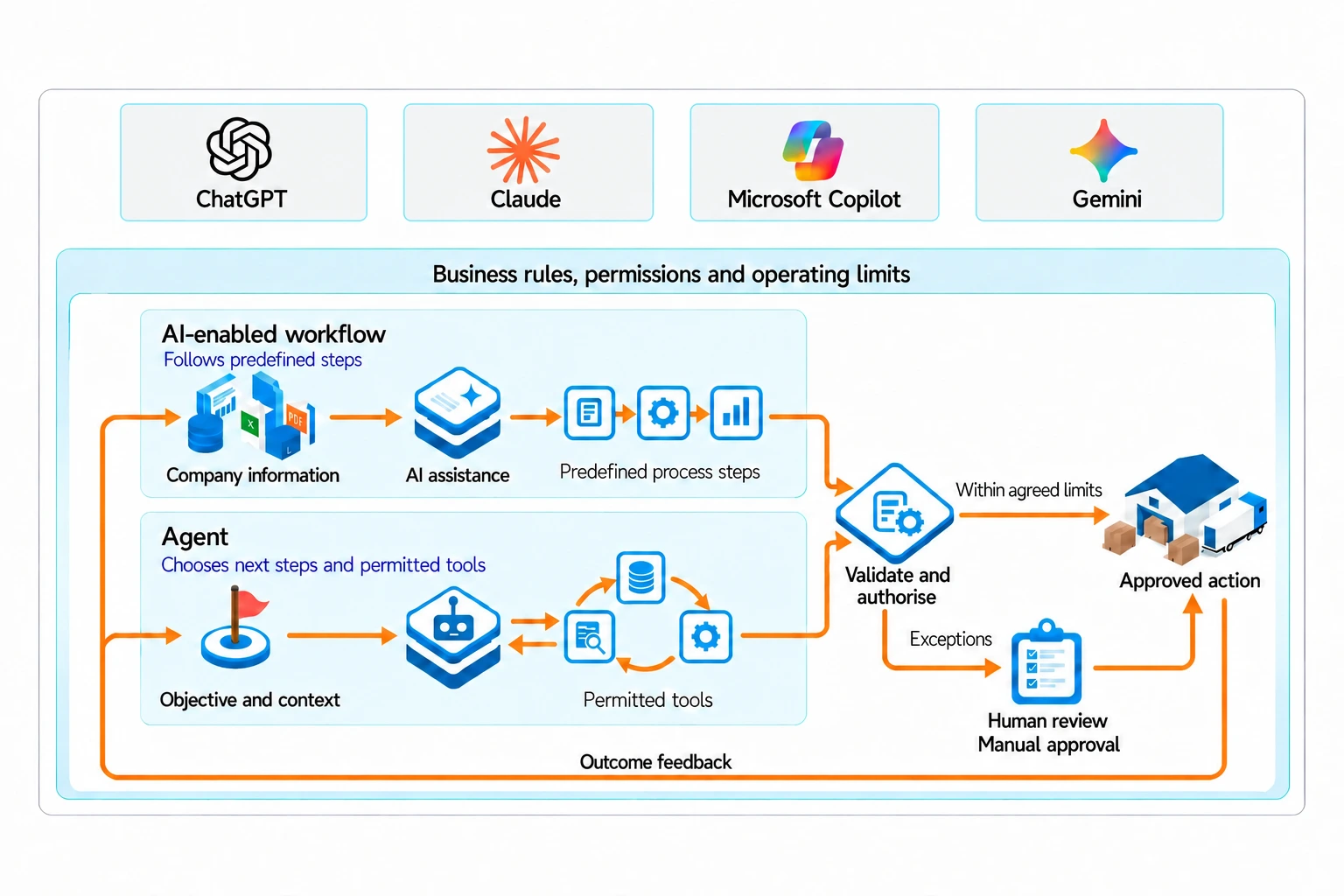
If every step follows a predefined route, we would usually call it an AI-enabled workflow. If the AI can choose its next steps and which permitted tools to use to achieve an objective, that is more commonly called an agent. Either approach can sit within the same business controls: an agent’s ability to choose a tool does not grant it unrestricted authority to change records or make commitments.
SCP would assess four options:
- Rules or existing automation: use a reliable calculation or workflow where the inputs and decisions are well defined.
- An assistant: let a person request a draft, explanation or comparison and decide what to do.
- An AI-enabled workflow: retrieve approved information and follow predefined process steps, including AI assistance where useful. Validate proposed actions and apply either pre-authorised automatic approval or the required human review.
- A bounded agent: allow the system to choose among permitted tools when the route varies, with explicit limits, monitoring and escalation.
How to read the diagram
The two panels show alternative approaches, not consecutive stages. In the upper panel, company information moves through AI assistance and predefined process steps. In the lower panel, an objective and operating context guide an agent that chooses its next step, uses permitted tools and considers the returned information before continuing or stopping. The provider logos are examples of available AI services; the diagram does not require all four to be connected.
The surrounding band represents business rules, permissions and operating limits applying throughout both approaches. Each tool must enforce its permissions and limits when called. Any call that changes a record or performs an external action must receive the required validation and authorisation before that call executes; checks cannot simply wait until the agent has finished. A separate rules engine can implement some controls, but is not mandatory and is not the whole agent.
The shared Validate and authorise checkpoint represents this action control. Proposals within the agreed scope can proceed automatically where that authority has already been granted. Exceptions go to Human review and manual approval, or stop pending resolution. Review can reject or return a proposal for correction; the arrow to approved action applies only when approval is granted.
Outcome feedback returns to company information and the agent’s objective and context so that the next decision uses the latest permitted evidence. It does not automatically change the business objective, extend permissions or instruct the system to repeat an action. The diagram simplifies these controls for communication; an implementation may apply the checkpoint repeatedly as work progresses.
A useful agent needs an objective, approved information, permitted tools, stopping rules and an accountable owner. Creating several agents is not a prerequisite for value. A repeatable workflow may be easier to understand, test and support.
How would it fit into an existing process?
Consider a supplier delay email. In this proposed operating example, AI extracts the supplier’s stated date and reason; a controlled connection retrieves the purchase order and affected customer orders. Established business rules calculate exposure. AI prepares a concise exception summary with references. In this exception case, the planner reviews it and grants or rejects the required approval before the relevant system is updated. A routine validated status update could follow the automatic route instead, if it falls within the previously authorised scope.
The AI should flag an ambiguous date or unmatched order rather than invent a value. A repeated email must not produce a duplicate change. If the source system is unavailable, the workflow should stop or use an agreed fallback. This example describes a design to test, not a deployed SCP client solution.
- Map and specify: document the current process, requirements, exceptions, owner and acceptance criteria.
- Prepare information: identify authoritative records, access permissions and update frequency. Retrieval can supply relevant approved material to the model without assuming it has learned the company’s latest procedures.
- Connect carefully: use supported connectors or APIs, initially with read-only access. Keep credentials and permission enforcement outside the model’s instructions.
- Test the whole journey: assess extraction accuracy, system integration, business acceptance, performance and recovery, including wrong inputs and unavailable systems.
- Release and monitor: assign support, record decisions and overrides, limit actions and costs, and retest after model, data or process changes.
Automate routine work and route exceptions to people
NIST’s Generative AI Profile identifies risks including confidently false content, privacy and information-security failures, and problematic human reliance. It supports lifecycle evaluation and risk management; it is not a guarantee that a particular application is safe. [11]
Not every repeatable activity needs a person to approve every transaction. In SCP’s proposed design, controls check required data, permissions and agreed tolerances before and during processing, with a final validation and authorisation checkpoint before action. Routine cases that pass those checks can proceed automatically within a previously approved scope. Missing information, conflicting records, out-of-tolerance values and actions outside that scope go to a person or stop pending resolution.
For example, an agreed rule might allow a validated status update to be recorded automatically. A changed delivery commitment, an unmatched order or a proposed quantity change outside an authorised range would be routed for review. The process owner sets those rules and tests them; a model’s own assertion that it is confident is not sufficient approval. Record automatic actions, monitor exceptions and retain a stop and recovery mechanism.
SCP would make review specific: who checks which facts, against what records, before which action? A reviewer needs process knowledge, access to the evidence, time to challenge the output and authority to reject it. Checking by asking a second model is not equivalent to checking the source record.
Keep spending, payments, stock release and customer commitments within the appropriate business authority, including any explicitly approved automation limits. Treat instructions hidden in external emails or documents as untrusted content. Log the information used and the resulting action, and retain a way to intervene. Low-risk drafts and high-consequence decisions should not share the same release rules.
What might the future change?
Current provider platforms already support connected information and multi-step tools. It is reasonable to expect more work to be offered through these interfaces, but the pace, reliability and financial impact remain uncertain. More capable models do not automatically resolve poor master data, conflicting objectives or unclear ownership.
SCP outlook: companies should prepare for tasks and roles to change, rather than assume every role disappears or every process becomes autonomous. People may spend less time assembling information and more time defining requirements, managing exceptions and checking outcomes. Retain expertise and training so the business can challenge the system and operate when it fails.
A credible investment case compares the present process with a tested alternative, including licences, integration, review, support, errors and change costs. Start where the benefit is observable and the consequences can be controlled; expand when evidence supports it.
Turn AI interest into a practical operating design
Supply Chain Partners can work with clients to design and implement AI-enabled workflows, or create suitable agents around an agreed business objective. We start with the process and the decision that needs to improve, then define the information, system connections, permitted tools and operating limits needed to make the solution useful.
For a workflow, this means defining the sequence of steps and where AI assistance fits. For an agent, it means agreeing the objective, available context, permitted choices and conditions for escalation. Both need clear ownership, validation before actions are taken and a practical route for people to review exceptions.
Our support can cover opportunity assessment, requirements and solution design, configuration or development with the client and its technology providers, integration, testing and a controlled pilot. We help agree acceptance criteria, measure results and prepare the training, support and monitoring needed for day-to-day operation.
- Business Analysis and requirements →
- Systems and trading-partner integration →
- Testing and Business Acceptance →
- Programme Management and delivery controls →
Discuss AI workflows and agents in an AI Discovery Workshop →
Sources and evidence notes
Research checked 30 October 2026. Measured studies, provider descriptions and SCP recommendations have different scopes. Provider comparison is a practical shortlist, not a tested product ranking.
- Brynjolfsson, Li and Raymond: Generative AI at Work ↗
QJE, May 2025. Published study: 5,172 customer-support agents; 15% average improvement in issues resolved per hour. Earlier working-paper versions use different sample counts and estimates. One-company deployment, not a universal savings forecast.
- Dell’Acqua and colleagues: Navigating the Jagged Technological Frontier ↗
Published 2026; experiment originally reported in 2023 with 758 consultants. Outside-frontier correctness difference is 19 percentage points. Selected tasks and earlier technology; not a ranking of current products.
- OpenAI: Data Science use cases ↗
Official product guidance reviewed 30 October 2026. Describes reviewable data-analysis uses; not independent performance evidence.
- Anthropic: What is the Enterprise plan? ↗
Official product guidance reviewed 30 October 2026; features and connections depend on configuration and plan.
- Microsoft: How grounding works with a work or school account ↗
Official guidance reviewed 30 October 2026. Work-data access differs by licence and permissions; the Copilot brand covers multiple products.
- Google Workspace: Workspace apps available for the Gemini app ↗
May 2025 release guidance, reviewed 30 October 2026. Supported connections require applicable administrator settings; no cross-provider benchmark.
- Microsoft: Agents in Microsoft Foundry ↗
Official implementation documentation reviewed 30 October 2026. Product naming and availability can change.
- AWS: Amazon Bedrock documentation ↗
Official implementation documentation reviewed 30 October 2026. Includes models, agents, flows, retrieval and security controls.
- Google Cloud: Agent Platform overview ↗
Official documentation reviewed 30 October 2026; describes Gemini Enterprise Agent Platform as an evolution of Vertex AI.
- Anthropic: Building effective agents ↗
Provider engineering guidance, originally December 2024, reviewed 30 October 2026. Workflow/agent distinction and simplicity principle; not independent return-on-investment evidence.
- NIST: Generative Artificial Intelligence Profile, AI 600-1 ↗
July 2024 voluntary risk-management guidance. Reviewed 30 October 2026; not a certification or legal determination.