About Supply Chain Partners
Independent thinking. Connected delivery.
Supply Chain Partners Group Limited is a consultancy connecting people, process and technology. Our work brings business analysis, supply chain thinking and collaborative delivery together around each client’s needs.
Why Supply Chain Partners?
End-to-end perspective. The right partners.
Our name reflects how we work. Supply Chains connect organisations, functions and services—and successful change depends on those connections working effectively.
Supply Chain Partners Group Limited connects people, process and technology across the end-to-end Supply Chain. We start with the business need, then consider the changes, expertise and partnerships required to address it.
We bring together the expertise appropriate to an engagement, which may include consulting specialists, technology partners and service providers. The client’s requirements shape the approach.
Advice shaped by your requirements.
Our consultancy advice remains independent of any obligation to recommend a particular software vendor. Where technology is appropriate, we assess its role against your processes, priorities and intended outcomes.

Meet Robert Smith
Understand the problem. Define the possibilities.
Robert’s approach centres on business analysis: understanding how a business works today and what it needs to become.
That means exploring existing processes, identifying pain points and clarifying a client’s vision and aspirations. From there, the focus moves to the target operating model, future processes and a practical roadmap for change.
The answer may involve improving an internal process, clarifying responsibilities or enabling change through technology.
Start a conversation →Our improvement approach
The SCP continuous improvement approach
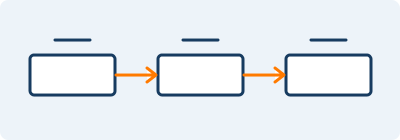
Six connected stages. The right techniques for the problem, clear outputs and evidence before moving forward.
Follow stages 1–6. Define acceptance criteria before testing; use test results and UAT evidence to support the authorised acceptance decision.

Stage 1: Define
Agree the problem and what success means.
- Techniques
- Requirements, user stories, SIPOC and baseline measures.
- Output
- Agreed scope, owner and initial acceptance criteria.
Decision
Are requirements and success measures clear?
Stage 2: Understand
See how the operation actually works.
- Techniques
- Observation, process mapping and data checks.
- Output
- Validated current state and evidence gaps.
Decision
Is the evidence reliable enough to diagnose?

Stage 3: Diagnose
Test causes and prioritise risks.
- Techniques
- Pareto, fishbone, Five Whys and FMEA.
- Output
- Evidence-supported causes and priority risks.
Decision
Do the findings support a change?

Stage 4: Design
Design the change and how to test it.
- Techniques
- Use cases, options appraisal, acceptance criteria and test planning.
- Output
- Selected change and traceable tests, owners and guardrails.
Decision
Are acceptance criteria agreed and linked tests ready?

Stage 5: Test, prove and embed
Test against agreed criteria before wider rollout.
- Techniques
- Testing, UAT where applicable, measured pilot and training.
- Output
- Test results, UAT evidence where required, defects and pilot outcomes.
Decision
Does the evidence support authorised acceptance and rollout?

Stage 6: Sustain and improve
Keep the gains and use what you learn.
- Techniques
- Control plan, performance monitoring and Kaizen.
- Output
- Owned controls, benefits review and next priorities.
Decision
Sustain, adapt, stop or begin the next cycle?
Learn, revisit and repeat
Evidence unclear? Return to Understand or Diagnose. Pilot misses the criteria? Revisit Design before rollout. Use the benefits review to agree the next improvement and return to Define.
We select established quality and improvement techniques around the operation, evidence and risk. The scope, responsibilities and delivery arrangements are agreed for each engagement.
What working with us feels like
Professional in our work. Approachable in our relationships.
A structured approach, clear communication and a friendly working style.
Rigour with a purpose.
We use analysis techniques and documentation to make complex problems easier to understand, discuss and resolve.
A shared understanding.
We work alongside client teams to clarify the challenge, explain options and make the decisions ahead easier to communicate.
Open, collaborative conversations.
We want clients to feel comfortable asking questions, challenging assumptions and contributing their operational knowledge throughout an engagement.
Start with a conversation about your operation
Explore the services relevant to your challenge, or speak with us about the decision you need to make.